

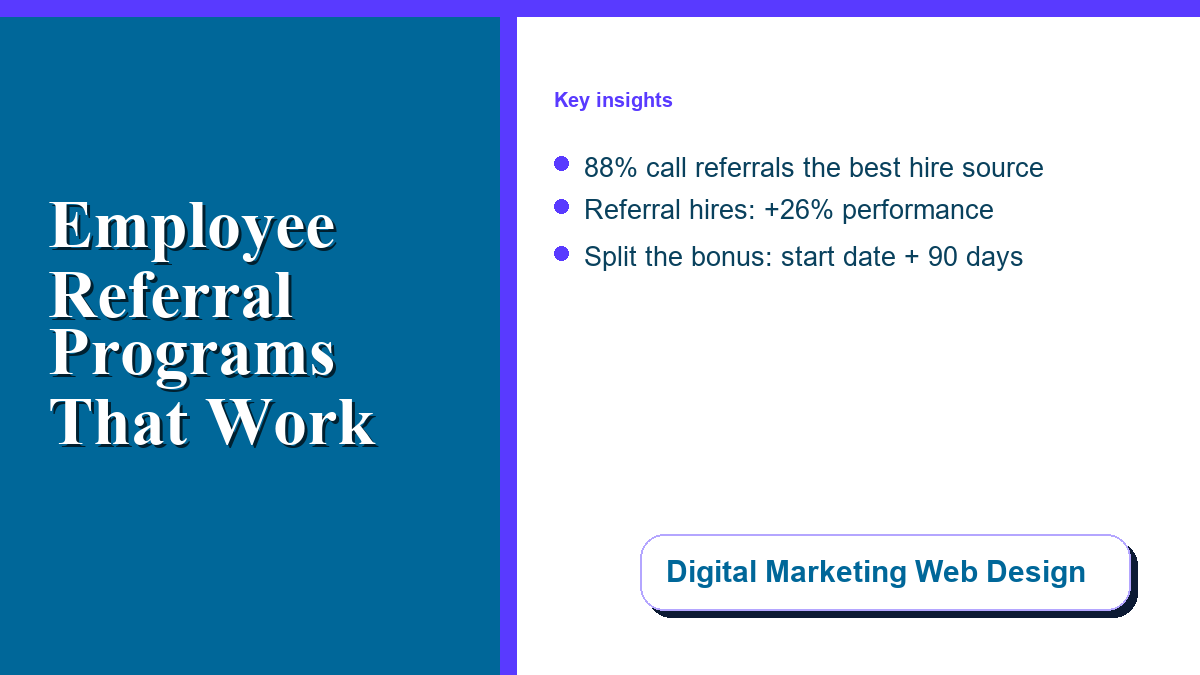
88% of employers rank employee referrals as their single most effective source of quality applicants — ahead of job boards, recruiters, and every paid channel combined. Most small businesses still treat referrals as something that happens if it happens, rather than a real hiring channel with its own process, and that gap is costing them measurably better hires.
Table of Contents
The Numbers That Make the Case
Referral hires outperform non-referral hires by 26% on first-year performance reviews, and cost roughly $1,000 less per hire than other channels — a candidate who already has an internal advocate needs less selling and less onboarding hand-holding. Retention tells the same story from a different angle: referral hires retain at 46%, against 33% for candidates sourced from job posting sites, and annualized retention across strong referral programs reaches over 81%.
Why Most Programs Underperform Anyway
The best 2026 employee referral programs are not the ones with the biggest bonuses — they’re the ones with the tightest workflow and the most engaged group of regular referrers. On average, each employee submits about 1.6 referrals total, and roughly 29% become repeat referrers — but a small core, under 4% of participants, accounts for a disproportionate share of all referrals submitted. A program built only around a big one-time bonus misses that the real lever is making it easy and normal for that core group to keep referring, not maximizing the payout for a single submission.
Structuring the Bonus
Average referral bonuses vary widely by industry — roughly $3,800 in healthcare, $2,500 in construction, $840 in hospitality, and $2,000–$5,000 in tech and professional services. More than half of programs split the payout into two installments, one at the new hire’s start date and a second at 90 days, which keeps the referring employee invested through the period where a bad hire is most likely to not work out.
Making Sure People Actually Know the Program Exists
Nearly half of frontline employees learn about their company’s referral program through a direct text campaign rather than an email or a handbook mention — a reminder that a referral program nobody remembers exists cannot generate referrals, however generous the bonus is on paper. A program relaunched quarterly with a short, direct reminder consistently outperforms one that was announced once at onboarding and never mentioned again.
The Broader Case for Building Incentives Into How a Business Grows
Employee referrals are one specific application of a wider principle: structured incentives consistently outperform hoping people act on goodwill alone, whether the goal is new customers or new hires. For the fuller case on why incentive-based programs outperform organic word of mouth across a business, not just in hiring, see our piece on the benefits of incentive marketing.