

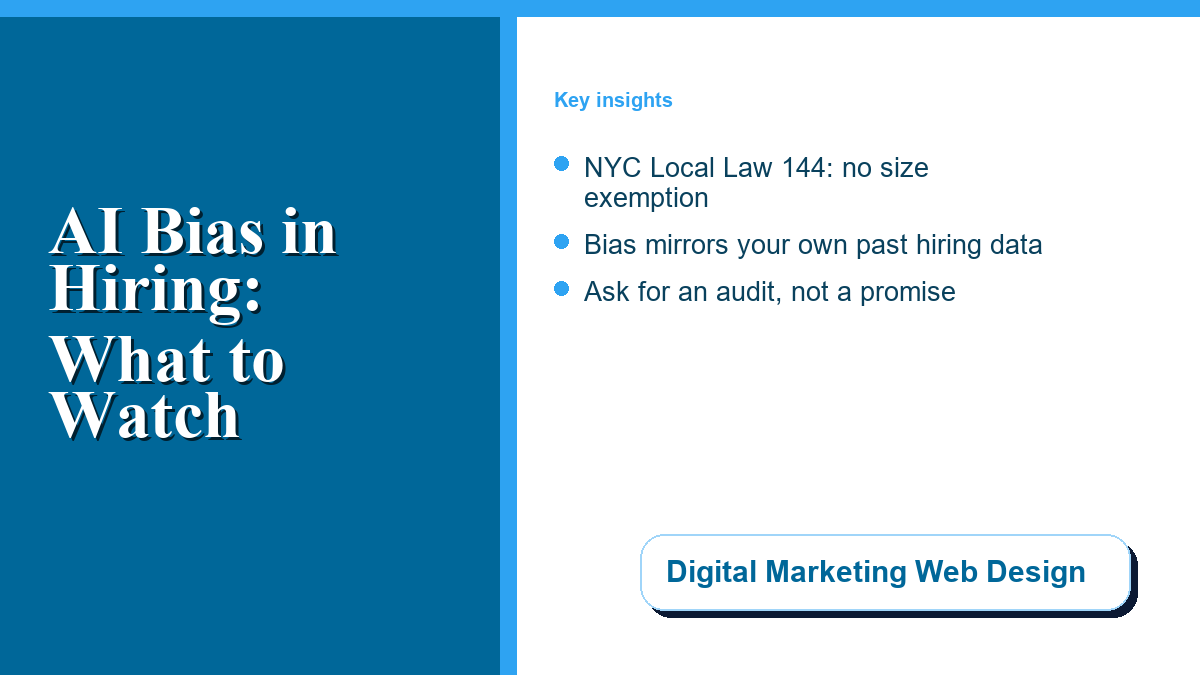
A small business using an AI tool to screen resumes is not exempt from bias law just because it’s small. New York City’s Local Law 144 applies to any employer using an automated hiring tool with no employee-count threshold at all — a ten-person company faces the same core obligation as a Fortune 500 firm, and similar laws are spreading to other states.
Table of Contents
Where the Bias Actually Comes From
Algorithmic bias in hiring isn’t usually a flaw in the technology itself — it’s a mirror of the historical hiring data the tool was trained on. If past hiring decisions at a company, or across the industry data a vendor trained on, favored certain candidates over others, the algorithm learns and automates that same pattern at scale, faster and less visibly than a single biased human reviewer ever could.
What the Regulations Actually Require
Where these laws apply, they require an independent bias audit of the hiring tool, testing for disparate impact across race, gender, and other protected categories, repeated annually or after any significant change to the model. Audit costs run $5,000 to $50,000 depending on the tool’s complexity — a real cost, but one usually built into the vendor relationship rather than something a small business commissions independently.
The Question That Actually Matters When Choosing a Vendor
For a small business buying an off-the-shelf AI hiring tool rather than building one, the practical move is verifying whether the vendor has already commissioned an independent bias audit covering the business’s specific use case and jurisdiction — not just accepting a general “our AI is fair” marketing claim. Vendor bias-mitigation claims have frequently turned out to be unsubstantiated: vague definitions of bias, no disclosed technical documentation, and no actual empirical evidence behind the fairness claim.
Practical Questions to Ask Before Signing
- Has this tool been independently audited for this specific use case, not just in general? A general fairness claim is not the same as an audit covering resume screening for this industry.
- What data was the model trained on? A vendor that cannot answer this is asking for trust without evidence.
- What happens when the tool flags a decision as high-risk? A tool with no human review step for edge cases is automating the bias, not catching it.
The Bigger Debate This Sits Inside
Hiring bias is one specific, well-documented example of a much broader question about whether AI systems narrow or widen existing inequities as they get deployed more widely across business and society — a debate our piece on whether AI helps or hinders gender equality looks at directly.
The Practical Takeaway
A small business does not need to become an AI ethics expert to hire responsibly — it needs to ask its vendor for evidence, not reassurance, before an automated tool ever makes or influences a hiring decision.