

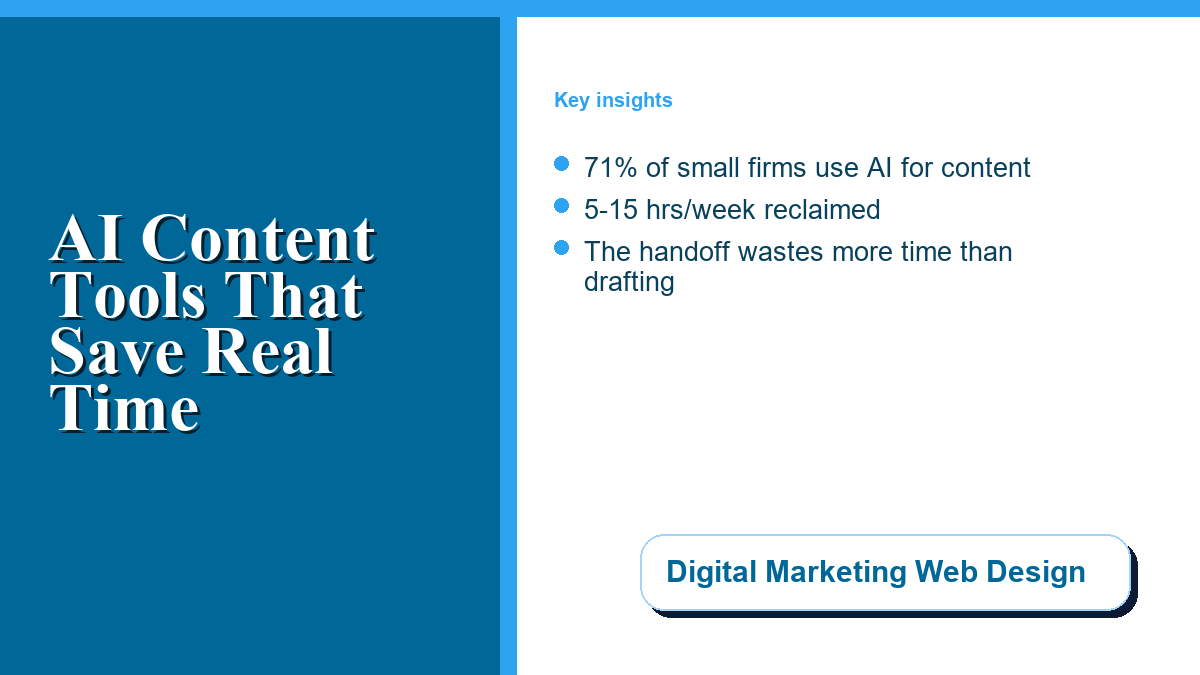
AI content tools are the single most adopted AI use case for small businesses — roughly 71% of AI-using small businesses report using one for writing or content generation, ahead of customer service, scheduling, and every other category. The tools that actually save a marketing team time in 2026 are not the ones that write the most text fastest; they’re the ones that cut the steps between an idea and a published piece.
Table of Contents
Where the Time Actually Goes
AI-using small businesses report reclaiming 5 to 15 hours a week on content work — but almost none of that comes from the writing step itself. It comes from everything around the writing: research that used to take an hour compressed into ten minutes, a first draft that used to start from a blank page starting from a structured outline instead, and formatting and scheduling work that used to be manual now happening automatically. A tool that only speeds up typing misses most of the actual time sink.
The Real Bottleneck Is the Handoff, Not the Draft
Most marketing teams do not lose time writing — they lose it moving a piece of content between disconnected tools: research in one app, drafting in another, image generation in a third, scheduling in a fourth, with someone manually copying context between each step. A connected pipeline that keeps research, brief, draft, and publishing in one place removes that handoff tax entirely, which is where the real hours get reclaimed rather than in the drafting step alone.
What to Actually Look For
- Does it remember your brand voice, or start fresh every time? A tool that requires re-explaining tone and audience on every request is not actually saving time, it is relocating the work.
- Does research turn into a brief automatically, or is that still a manual step? The gap between “here’s a keyword” and “here’s a structured brief” is where a lot of tools quietly leave you to do the thinking yourself.
- Can it publish directly, or does content still need to be copy-pasted into a CMS? A tool that stops at “here’s a draft” is solving half the problem.
Platforms built around a full content pipeline — keyword research through a brief, a reviewed draft, and direct publishing — close more of that loop than a standalone writing tool. Charigent’s Content Engine is one example built specifically around keeping that research-to-published chain in one place rather than splitting it across separate tools.
The Real Measure of Whether It’s Working
The right test for any AI content tool is not “does it write well,” most of them do by now. It is “does my team spend less total time from idea to published piece than it did six months ago.” If the answer is no, the tool sped up one step while leaving the rest of the pipeline exactly as slow as it always was.