

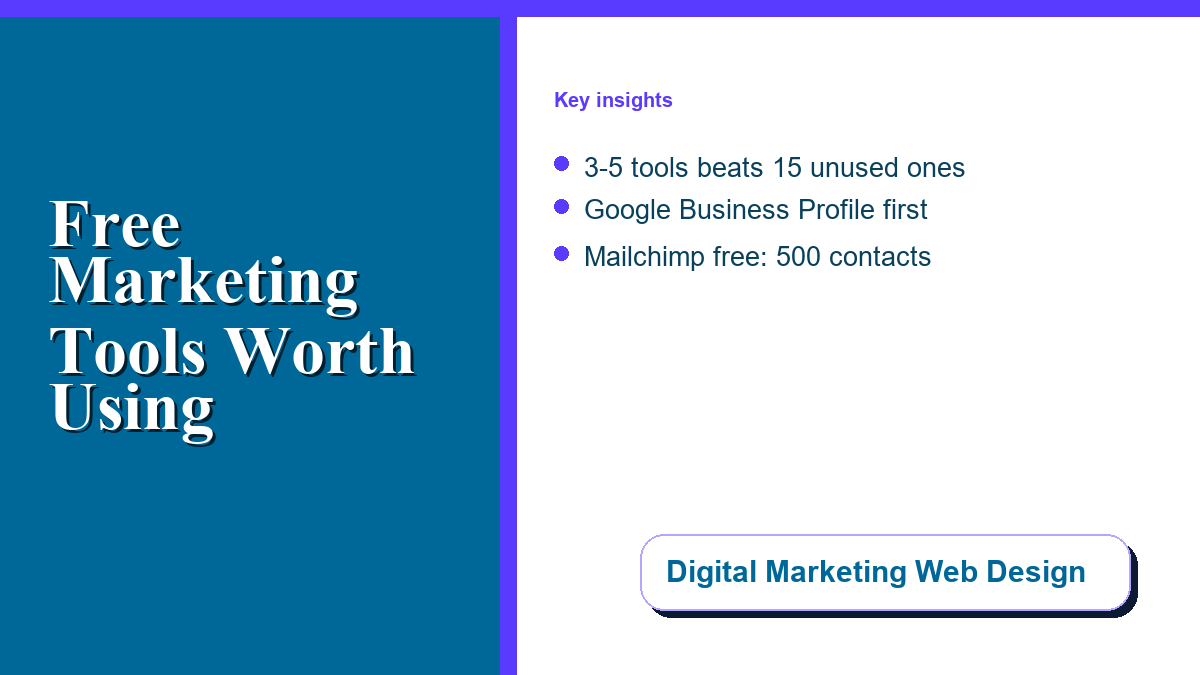
Most small businesses do not need fifteen marketing tools. They need three to five that actually get used, and in 2026 a surprising number of the best options are still free at the tier a small business actually needs. The mistake is usually not picking a bad tool — it is stacking too many good ones and never using most of them.
Table of Contents
The One Every Local Business Should Set Up First
Google Business Profile is free, and it directly controls how a business appears in Google Search and Google Maps — hours, photos, reviews, and posts. For a business with any local customer base, this is the single highest-leverage free tool available, and it is also the one most frequently left half-filled-out or unclaimed entirely.
Email: Build the List Before You Need It
Mailchimp’s free plan covers up to 500 contacts and 1,000 emails a month, with basic templates and automation included — enough for most businesses to run a real email program before paying for anything. EmailOctopus and Brevo are worth a look too, particularly Brevo, which includes automation features that some competitors reserve for paid tiers. The tool matters less than starting the list early; a business that waits until it “needs” email marketing has already lost a year of subscribers it could have been collecting for free.
Social Media Without the Daily Grind
Buffer’s free plan connects three social channels and schedules ten posts per channel — enough to keep a consistent posting rhythm without logging into four apps every morning. Consistency matters more than volume here: a business posting three times a week on a schedule outperforms one posting daily in bursts and then going quiet for two weeks.
Design Without a Designer
Canva remains the fastest way for a non-designer to produce social graphics, flyers, and ad creative that look professional rather than homemade. It will not replace a brand identity built by a real designer, but for day-to-day content it removes the single biggest bottleneck most small businesses have: not having anyone available to make a graphic on short notice.
Measuring What Actually Worked
Google Analytics 4 and Google Search Console round out the free stack, and together they answer the question every other tool eventually raises: is any of this actually working? A lean stack of five tools used consistently and measured properly outperforms a stack of fifteen tools that mostly sit unused.
For a wider list of tools organized by what they solve rather than just what they cost, see our guides to business advertising apps for small business promotion and the essential apps to grow your business for free, both of which go deeper on specific categories than the core five covered here.