

A discount that feels generous to a customer can be quietly destructive to a business, and the math behind why is more brutal than most owners expect until they actually run it. A well-designed incentive grows the business; a carelessly-priced one just moves profit from the business to the customer for no strategic reason.
Table of Contents
The Math Most Owners Skip
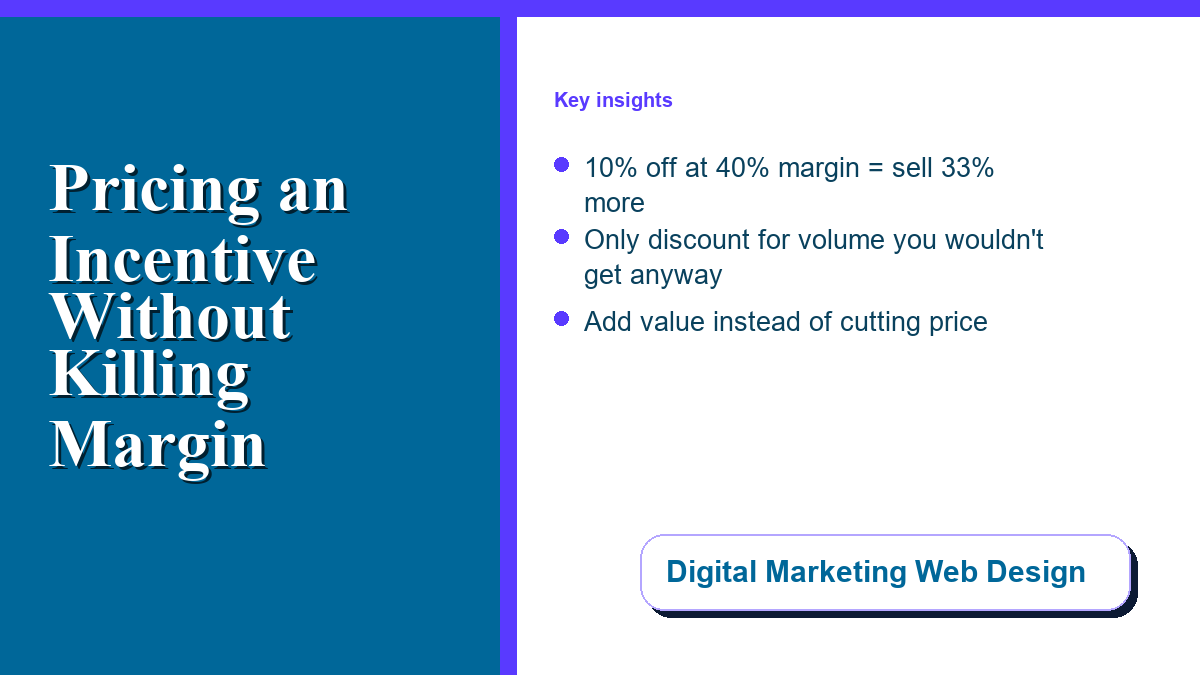
A 10% discount on a product with a 40% profit margin requires selling 33.3% more units just to break even on total profit — not to come out ahead, just to stay flat. That number surprises most business owners the first time they calculate it, because a 10% discount feels small and a 33% sales increase feels like a lot to ask for in return.
The One Condition That Makes a Discount Worth Running
An incentive is only worth offering if it attracts volume that genuinely would not have shown up otherwise — a new customer segment, or meaningfully more volume from existing customers — and that additional volume has to more than offset the margin given up on customers who would have bought anyway at full price. A discount handed to people who were already going to buy is pure margin loss with no offsetting growth; the entire case for running one rests on reaching people or purchases that wouldn’t otherwise happen.
Structuring an Incentive to Protect Margin
- Volume-based instead of blanket. A discount that only kicks in above a purchase threshold raises average order value instead of just cutting revenue on transactions that were already happening.
- Add value instead of cutting price. Free installation, a bonus service, or an added feature often costs less to provide than the equivalent discount costs in margin, while feeling just as generous to the customer.
- Know your break-even before you set the number. Break-even is fixed costs divided by contribution margin per sale — that number should set the ceiling on any discount, not a competitor’s price or a round number that sounds generous.
Watching the Result, Not Just Running the Promotion
The businesses that use incentives well track the actual lift against the actual margin cost after the fact, not just whether the promotion “felt successful” from redemption volume alone. A widely-redeemed discount that didn’t bring in a single new customer is a worse outcome than a modestly-redeemed one that brought in twenty, even though the first one looks more successful on a participation report.
The Bigger Picture
Pricing discipline and incentive strategy aren’t opposites — a well-priced incentive is a growth tool precisely because it was priced with the business’s actual margin in mind, not despite it. For the fuller case on why structured incentives outperform organic word of mouth when they’re built this way, see our piece on the benefits of incentive marketing.