

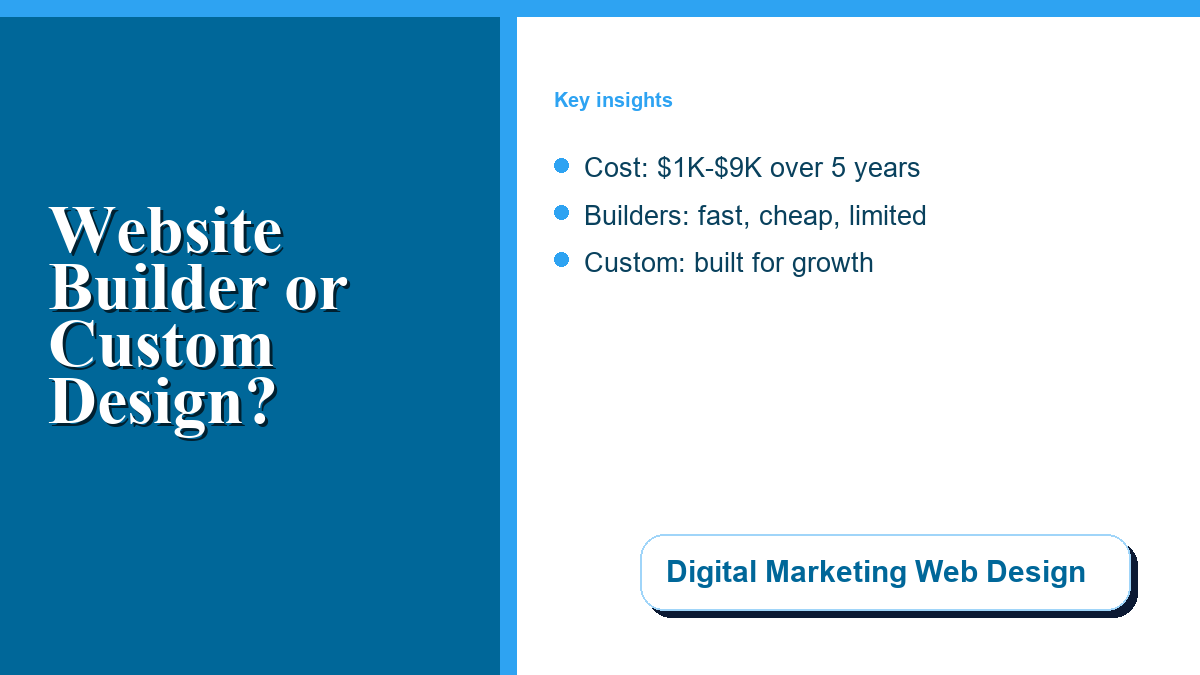
Every small business owner researching a new website runs into the same fork in the road: pick a do-it-yourself website builder, or hire someone to build a custom site. Both routes produce a working website. They do not produce the same business outcome, and the gap between them is bigger in 2026 than it was a few years ago, now that AI-assisted builder templates make the DIY option look more capable than it actually is once a business starts to grow.
Table of Contents
What a Website Builder Actually Gets You
Website builders are genuinely good at one thing: getting a basic site live fast and cheap. Most run $15–$50 a month, and a business with its copy and images ready can have a template site up in a weekend. For a business that just needs a digital business card — hours, location, a phone number, a few photos — that is often enough.
The tradeoff shows up as the business grows. Millions of other businesses use the same template library, so differentiation is limited by design. The moment a business needs something the template does not natively support — a custom booking flow, a non-standard integration, a database-backed feature — the builder becomes the ceiling, not the floor. And because the business does not own the underlying code, moving to a different platform later usually means rebuilding from scratch rather than migrating.
What Custom Web Design Actually Costs
Custom pricing has a wide range because “custom” covers a wide range of work: a freelance designer typically runs $1,500–$8,000 for a small business site, while a full-service agency build runs $6,000–$35,000 depending on scope, plus ongoing hosting and maintenance. Compared over five years, a builder subscription usually totals $1,000–$2,500, against roughly $3,500–$9,000 for a custom build — on paper, the builder looks cheaper.
What that comparison leaves out is performance. A site built around actual SEO structure, real page speed work, and conversion-focused design tends to generate meaningfully more qualified traffic and leads than a templated build, which is why agencies that specialize in custom builds frame the extra spend as revenue infrastructure rather than a cost line. For a business where the website is a real sales channel — not just a digital brochure — that difference compounds every month the site is live.
A Simple Way to Decide
The decision usually comes down to three questions: Is the website a sales channel or a reference page? Does the business expect to need custom functionality within the next two years? And is the brand differentiation the site provides part of the actual sales pitch? A business answering “reference page,” “no,” and “not really” is well served by a builder. A business answering the opposite way is paying a premium every month it delays a proper build.
For businesses weighing the DIY route specifically, our guide to the best website builder themes for effortless website creation breaks down which templates hold up best if a builder is genuinely the right call for where the business is today.
The Middle Ground Most Businesses Miss
The false choice in most of this discussion is “builder now, custom later, and rebuild from zero when the time comes.” A more efficient path for a growing business is starting the custom conversation earlier than feels necessary — while the current site is still simple — so the build reflects where the business is headed rather than reacting to where a template already boxed it in.