

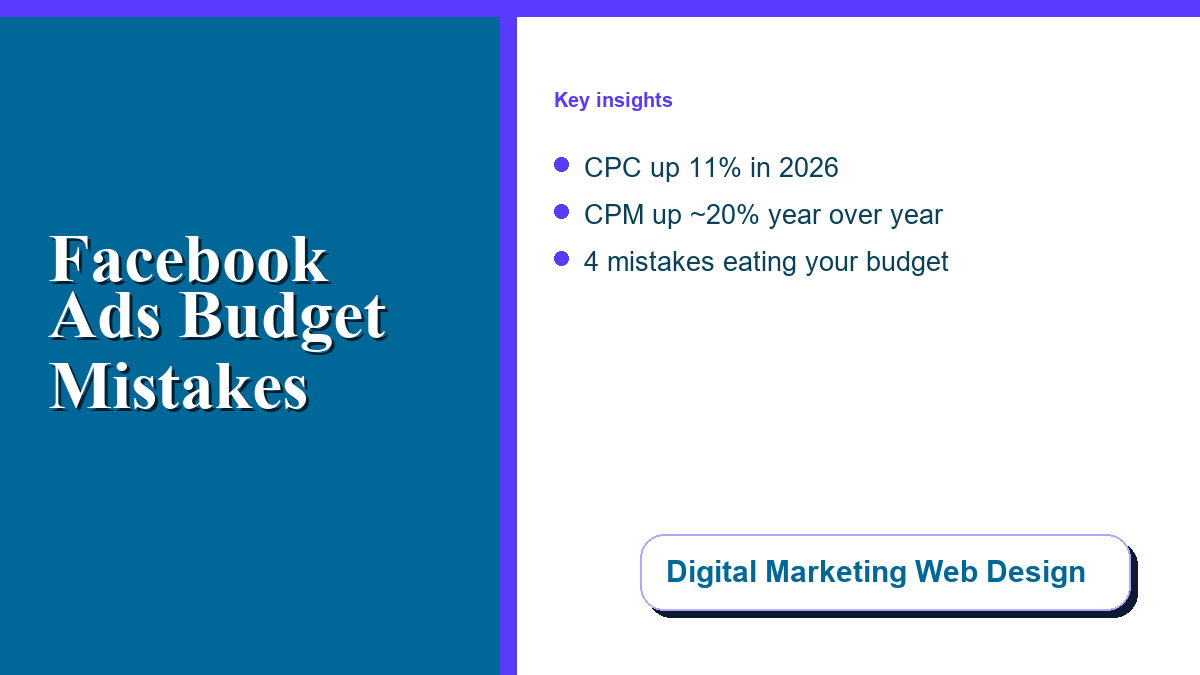
Meta advertising got more expensive in 2026, not less. Across industries, cost-per-click is up roughly 11% year over year, cost-per-mille is up around 20%, and cost-per-acquisition has climbed closer to 38% — driven by more advertisers competing in the same auctions and heavier reliance on AI-driven bidding. For a small business running the same budget and the same habits as last year, that alone can quietly erase a campaign’s return without anything on the business side actually going wrong.
Table of Contents
Mistake One: Setting a Budget Off Last Year’s Numbers
The most common error is treating last year’s cost-per-click as this year’s planning number. Current benchmarks put a realistic range around $0.70–$0.80 for traffic campaigns and roughly $1.90–$2.10 for lead-generation campaigns, with CPM running anywhere from about $7 to $12+ depending on industry — beauty and health sit at the high end, hardware and automotive at the low end. A budget built on outdated assumptions either overspends chasing a target it can no longer hit, or underspends and never gets out of the learning phase.
Mistake Two: Turning On Advantage+ Too Early
Meta’s automated Advantage+ Shopping campaigns can be genuinely effective, but they are built for scale: the platform recommends at least 50 weekly conversions and a daily budget in the $100–$300 range before automation has enough signal to optimize well. A business running fewer conversions than that and switching to full automation anyway is usually handing budget to an algorithm that does not yet have enough data to spend it well. Below that threshold, a manually structured campaign with defined audience segments still outperforms.
Mistake Three: Never Refreshing Creative
Rising costs are partly an auction problem and partly a creative problem. The businesses holding their cost-per-result flattest in 2026 are the ones treating ad creative as a rotating asset, not a one-time upload — testing new variations on a regular cadence rather than letting the same three images run until performance quietly decays. Creative fatigue shows up as a slow decline in relevance score long before it shows up as an obvious drop in results, which is exactly why it goes unnoticed until the budget stops working.
Mistake Four: Ignoring the Landing Page
A strong ad with a weak landing page is still a weak campaign. Relevance and quality scoring both weigh what happens after the click, so a landing page that loads slowly or does not match the ad’s promise drags the whole campaign’s efficiency down, even when the ad itself is well built. This is the mistake most likely to get blamed on “the algorithm” when the actual problem sits entirely on the business’s own site.
Building a Budget That Holds Up
Getting this right in practice means combining current benchmarks with a business’s own conversion data, not planning off either alone. Our Facebook Ads Blueprint walks through that process step by step — from setting an initial budget through structuring campaigns so they can graduate into automation once the volume actually supports it, rather than before.