

“Brand purpose” gets dismissed as a big-company luxury by a lot of small business owners — something for a global company with a marketing department, not a local shop trying to make payroll. The 2026 data says the opposite: purpose is actually a bigger advantage for small businesses than for large ones, because trust is the one asset small businesses already have that most large brands are actively losing.
Table of Contents
Trust Is Doing More Work Than Ever
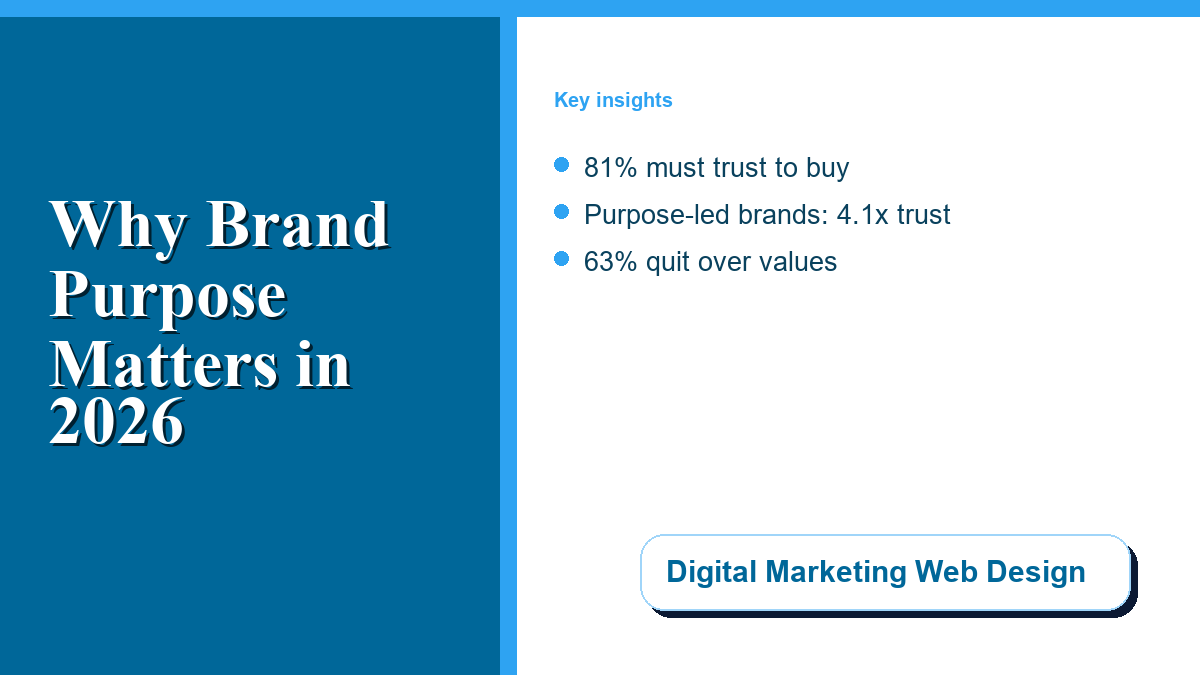
81% of consumers say they need to trust a brand before they will buy from it, and brands with a clearly defined purpose are 4.1x more likely to earn that trust than brands that compete on price or features alone. On the buying side, the effect is large: B2C consumers are 4 to 6 times more likely to choose a brand that stands for something specific over one that does not.
The Local Trust Advantage
Small businesses are sitting on a trust advantage most of them do not realize they have. Public trust in small business has climbed to its highest recorded level, and a majority of consumers now cite a direct preference for shopping local as a reaction to high-profile large-brand scandals. A small business does not need to manufacture purpose from nothing — it usually already has a real one, rooted in the community it serves, that a large competitor cannot credibly claim.
What Happens When Purpose Is Missing
The downside is just as real as the upside: 63% of consumers report permanently cutting ties with at least one brand in the past year over a values or ethics concern. Purpose is not a nice-to-have layered on top of good marketing — its absence, or worse, a purpose statement that does not match how the business actually operates, is now an active reason customers leave.
Turning This Into Something Practical
For a small business, brand purpose does not need a rebrand or a mission-statement workshop. It needs three things stated clearly and consistently: what the business actually does differently, who it serves and why that matters to them specifically, and proof — a policy, a practice, a track record — that backs up the claim rather than just asserting it. A purpose statement nobody can point to evidence for is marketing theater, and customers increasingly notice the difference.
For a deeper walkthrough of how to put this into words for your own business, see our guide on how to develop your brand’s purpose to strategically achieve your goals, which covers the process step by step.
The Bottom Line
The businesses winning on trust in 2026 are not the ones with the biggest marketing budgets — they are the ones whose purpose is specific, provable, and consistently visible in how they actually treat customers. For a small business, that is a genuinely winnable fight.