

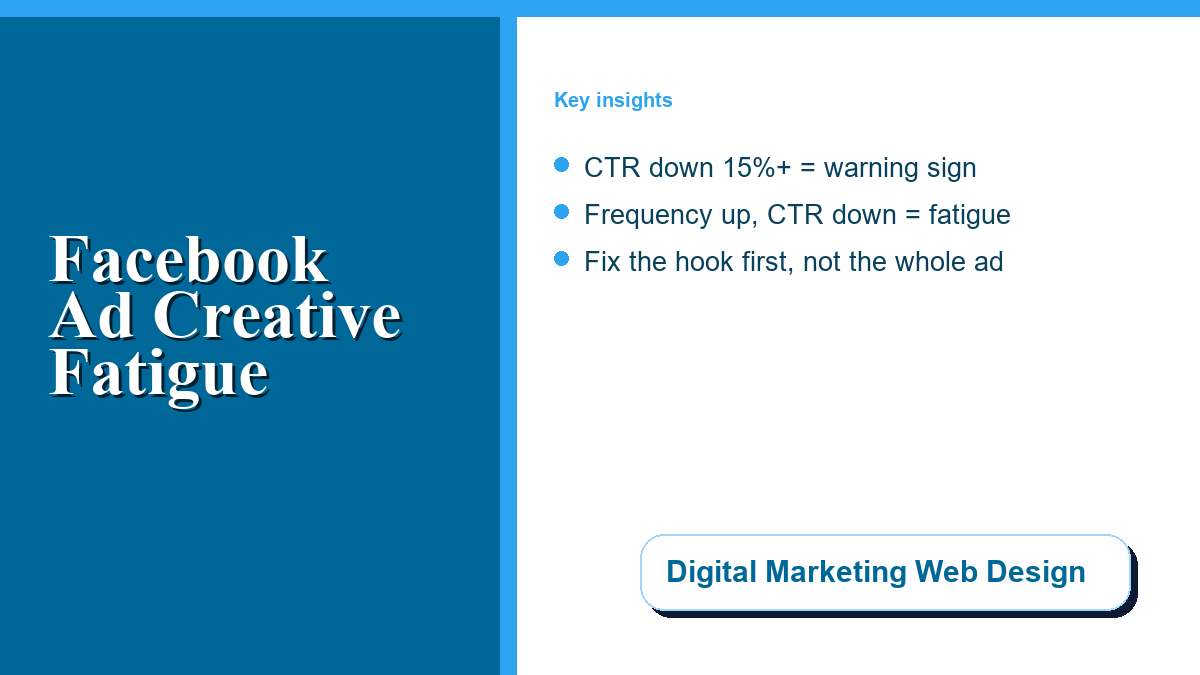
A Facebook ad that was working two weeks ago and is quietly underperforming today is not usually a targeting problem — it’s creative fatigue, and it is the single most common reason a campaign’s cost per result drifts upward with nothing else about the business having changed.
Table of Contents
The Signal That Actually Predicts Fatigue
Watch two numbers together, not separately: frequency rising and click-through rate falling in the same week is the reliable fatigue signature. Either one alone can be noise. Both moving in opposite directions at once means the same people are seeing the same ad enough times that it has stopped working on them.
The Specific Thresholds Worth Tracking
- Click-through rate down 15% or more against a 7-day rolling baseline.
- Cost per mille up 10% or more over the same window — the auction is charging more to reach the same audience because engagement has dropped.
- Hook rate down 20% or more — fewer people are watching past the first few seconds, meaning the opening no longer earns attention the way it used to.
- Frequency above 3.5 on prospecting campaigns specifically — retargeting can tolerate higher frequency, cold audiences cannot.
- Rising negative feedback — hides, “see less,” and reports climbing is often the clearest signal, because it is the audience telling the platform directly that they’re tired of the ad.
Why This Moves Faster Than It Used To
Creative cycles are shorter in 2026 than they were even two years ago. Automated delivery and broader audience strategies mean an ad reaches its full addressable audience faster, so the same creative wears out on a shorter timeline than the old “run it for a month” playbook assumed. People who see the same ad 6–10 times convert about 4% less often than people who saw it 2–5 times – a small number per person that adds up fast across a whole campaign.
The Fastest Fix Is Not a Full Rebuild
The hook — the first frame or first few seconds — does most of the attention-earning work and wears out first. When a proven ad starts to tire, changing the hook and opening frame alone fixes most of the fatigue with the least effort; a full creative rebuild is rarely necessary just because performance dipped. Refreshing from the top down, starting with the first three seconds, recovers most of what was lost before a full new creative is worth the production time.
Building This Into a Routine
A strategic refresh cadence — every 7 to 21 days depending on audience size and current frequency — keeps a campaign ahead of fatigue instead of reacting to it after cost-per-result has already climbed. For the fuller framework on structuring a campaign so fatigue doesn’t quietly erase the budget, see our Facebook Ads Blueprint.